
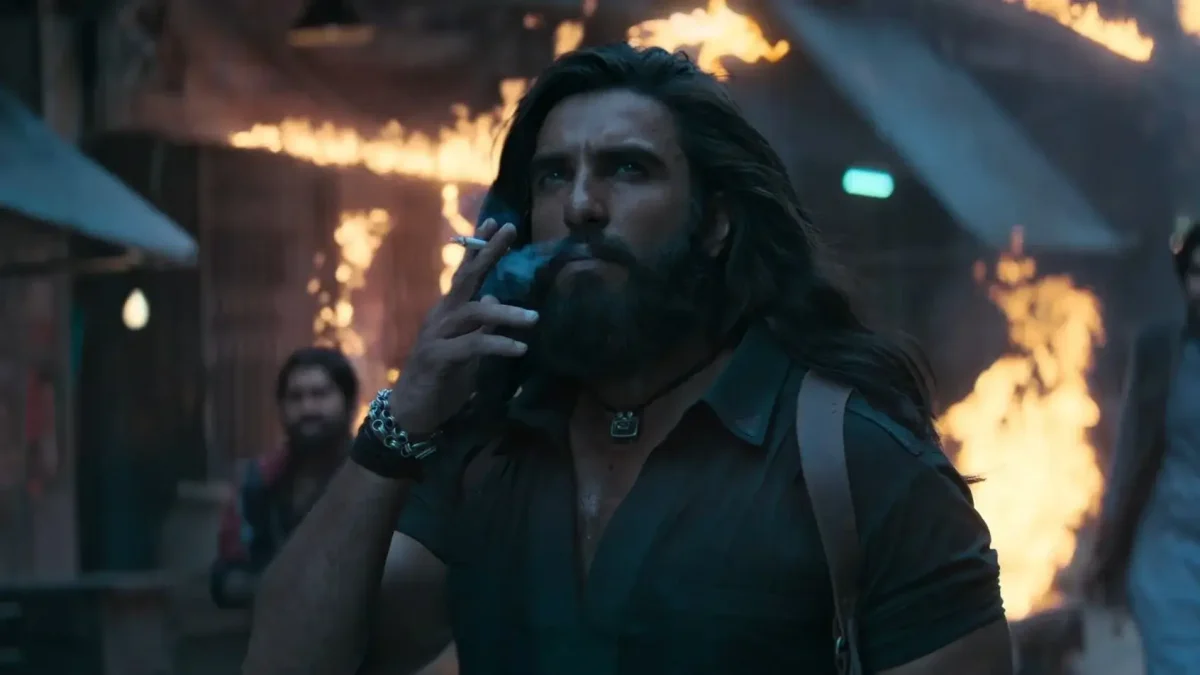
Dhurandhar 2 Trailer Review: Ranveer Singh Returns in Explosive Revenge Mode
Rating: 3.5/5
Dhurandhar 2 is an ambitious, blood-soaked continuation of Aditya Dhar's spy saga. Bigger, louder, and more politically charged than its predecessor, the film offers exhilarating action and solid performances, but its bloated runtime and uneven pacing stop it from reaching the highs of the original.
A Four-Hour Runtime That Feels Like a Marathon
I've never been a fan of excessively long films. Years of attending film festivals have conditioned me to believe that anything beyond two hours should justify every additional minute.
The first Dhurandhar surprised audiences because nobody knew what to expect. It unfolded like an unpredictable roller coaster. Dhurandhar 2 doesn't enjoy that luxury. Expectations are sky-high, and the nearly four-hour runtime feels far more demanding.
Like its predecessor, the sequel is divided into chapters with stylish intertitles. Unfortunately, those chapter breaks lack the creativity and wit that made the first film feel fresh. The universe has already been established; now the story must carry the weight. Naturally, the biggest question is where Hamza, also known as Jaskirat (Ranveer Singh), goes after eliminating his mentor, Rehman Baloch (Akshaye Khanna).
Dhurandhar 2 Turns Brutality Into Spectacle
The film wastes no time diving into violence.
An opening flashback shows Jaskirat slaughtering a corrupt MLA in Pathankot to avenge his family. The sequence is brutally staged, drenched in blood, and serves one primary purpose—to remind audiences that this world offers only two choices: execution or becoming a spy.
Back in Lyari, the power dynamics shift. Uzair rises through the ranks while Hamza becomes his trusted lieutenant. Every major character operates within morally grey territory, including Sanjay Dutt's Chaudhary Aslam, who seems remarkably comfortable navigating the criminal underworld.
While the political intrigue remains engaging, the storytelling struggles to maintain momentum.
The first half, stretching close to two hours, often drags. The narrative moves forward without generating consistent excitement. Only the arrival of Dawood Ibrahim injects genuine energy into the film. The audience erupted with whistles and applause during his introduction—a reaction that raises uncomfortable questions about our fascination with larger-than-life criminals.
Thankfully, the interval delivers an excellent payoff and finally reminds viewers why they invested their time.
Action Is the Film's Greatest Strength
Whenever Dhurandhar 2 embraces full-scale action, it becomes immensely entertaining.
The film constantly escalates its violence, presenting increasingly elaborate action sequences filled with brutal combat, explosive shootouts, and relentless bloodshed. These moments showcase Aditya Dhar's ability to stage stylish commercial action.
However, whenever the screenplay pauses to emphasize nationalism, the emotional impact weakens.
Jaskirat's unwavering patriotism and Dawood's loyalty to Pakistan are written with maximum intensity but limited nuance. Among all the patriotic characters, Arjun Rampal's Major Iqbal emerges as the most convincing because his motivations feel grounded rather than theatrical.
The Demonetization Chapter Is Surprisingly Entertaining
The second half opens with one of the film's strongest emotional confrontations before shifting into its most controversial section.
Aditya Dhar directly engages with recent Indian political events, particularly demonetization, dedicating an extended chapter to its impact on terrorism and national security.
Yes, the film carries clear ideological messaging.
But it never becomes particularly persuasive propaganda.
Most audiences are unlikely to reshape their political opinions based on a four-hour action thriller. Personal experiences will always outweigh cinematic arguments.
Ironically, this politically loaded stretch is also among the film's most entertaining.
Watching terrorists being systematically eliminated—with their names and affiliations flashing across the screen—is designed to generate crowd-pleasing satisfaction, and for the most part, it succeeds.
Interestingly, the film also undercuts its own triumphalism.
Major Iqbal openly acknowledges that eliminating one terrorist simply creates space for another. It's one of the screenplay's rare moments of genuine self-awareness and perhaps its most honest observation.
Less Masala, Less Magic
The original Dhurandhar felt like a classic 1980s commercial entertainer packed with twists, memorable music, and relentless surprises.
The sequel follows the same formula but executes it with noticeably less flair.
The editing lacks urgency, particularly during the first half, while the nostalgic soundtrack choices never achieve the same emotional impact as before.
At its heart, Dhurandhar 2 remains a straightforward revenge story disguised as a sprawling geopolitical thriller. It works best when viewed as an unapologetic action fantasy rather than a realistic political drama.
The film also spends considerable time highlighting the Azad Balochistan movement, portraying the oppression faced by young people in the region and adding another political layer to its narrative.
Performances: Ranveer Singh Carries the Film
Akshaye Khanna's absence is immediately noticeable.
His commanding presence elevated the first film, and the sequel struggles to replace that void.
Saumya Tandon returns briefly, repeats a familiar character beat, and exits almost as quickly as she arrives. Danish Pandor's Uzair never fully develops before disappearing from the story, only to return when it's too late to matter. Sanjay Dutt exits early, perhaps wisely, before his stylized performance begins to wear thin.
Rakesh Bedi and Gaurav Gera receive limited screen time but still leave a lasting impression.
Among the newcomers, Raj Zutshi is excellent, while Salim Siddiqui convincingly portrays a corrupt Uttar Pradesh politician. Sara Arjun appears in only one significant scene but delivers one of the film's most emotionally effective performances.
R. Madhavan once again proves why he remains one of Indian cinema's most dependable actors, effortlessly handling several of the film's biggest mass moments.
Arjun Rampal commands attention as Major Iqbal. His intimidating screen presence, combined with his complicated relationship with his father, introduces an interesting emotional dimension while exposing the toxic masculinity and brutality that define this world.
Yet the film unquestionably belongs to Ranveer Singh.
He delivers another physically demanding performance, successfully distinguishing Hamza from Jaskirat through subtle differences in body language, emotional restraint, and intensity.
Even when the screenplay indulges in exaggerated Bollywood action tropes, Singh's commitment keeps the character believable. His collaborations with Aditya Dhar continue to rank among the strongest performances of his career.
Aditya Dhar Builds a New Spy Universe
With the first two Dhurandhar films, Aditya Dhar appears determined to redefine the Indian spy thriller.
His storytelling combines historical events, contemporary politics, espionage, revenge, and commercial action into one sprawling cinematic universe.
His understanding of drama remains his greatest strength, even if his interpretation of global politics occasionally feels simplistic.
The screenplay is filled with playful references—from songs like Tamma Tamma and Tirchi Topiwale playing in the background to unexpected characters quietly influencing major events.
One of the film's more commendable choices is its restraint.
Despite dealing extensively with terrorism and Pakistan, Dhurandhar 2 avoids portraying Indian Muslims as villains. Since the story unfolds almost entirely inside Pakistan and focuses on organizations recognized internationally as terrorist groups, the narrative avoids unnecessary communal hostility.
That restraint ultimately strengthens the film.
Final Verdict: A Flawed but Entertaining Spy Thriller
Watching Dhurandhar 2 at an 11:45 PM show came with one unforgettable surprise—a young child sitting in the audience.
Given the film's graphic violence, it was clearly not intended for children, making the experience strangely amusing. Years from now, if someone fondly recalls Dhurandhar 2 as their first theatrical experience, it may say as much about changing parenting habits as it does about the film itself.
Dhurandhar 2 isn't as sharp, tightly edited, or consistently entertaining as the original. Its first half overstays its welcome, and its political messaging sometimes overshadows the storytelling.
Yet when Aditya Dhar focuses purely on action, suspense, and larger-than-life spectacle, the film becomes immensely satisfying. Ranveer Singh delivers another commanding performance, the action sequences are expertly staged, and the world continues to feel expansive enough to support future installments.
If you're expecting a grounded spy thriller, you'll likely be disappointed.
If you're willing to embrace it as a high-octane, hyper-nationalistic action fantasy with spectacular set pieces and a committed lead performance, Dhurandhar 2 is absolutely worth the ride—even if that ride lasts nearly four hours.
Comments 0